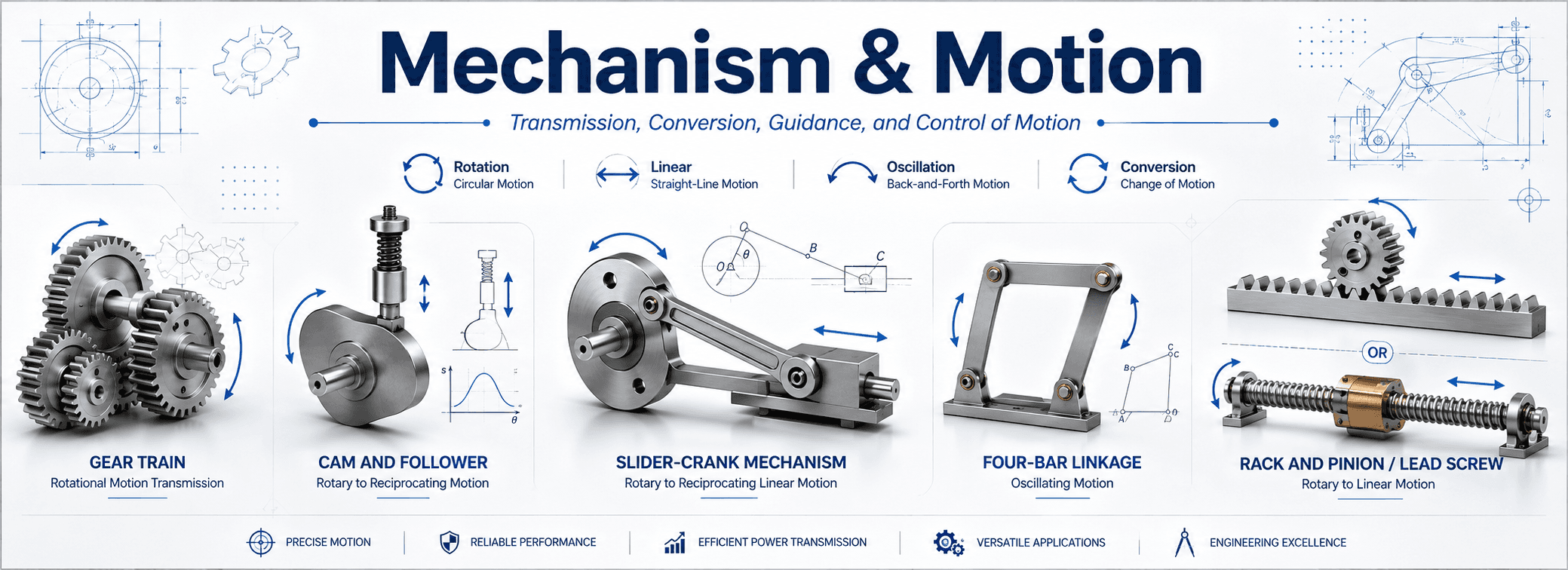
Mechanism & Motion

Classification and Design of Motion According to Motion Generation Method

In a mechanical system, motion does not simply mean that a component moves or rotates. In practice, a specific form of energy is supplied to a drive device,…

Classification and Design of Motion According to Speed and Position Characteristics

Motion in a mechanical system is defined not only by the path an object follows, but also by how fast it moves, how its speed changes, where it stops, and…

Classification and Design of Motion According to Time Characteristics

Motion in a mechanical system is defined not only by the path an object follows, but also by when it moves, how long the movement continues, how often it…

Classification and Design of Motion According to Motion Trajectory

In mechanical systems, motion refers to the change in the position or orientation of a component or mechanism over time. Motion can be classified according…

Compliant and Flexible Mechanisms

Compliant and flexible mechanisms are mechanical systems that permit a controlled amount of structural deformation or relative motion when external force,…

Elastic and Return Mechanisms

Elastic and return mechanisms are mechanical systems that deform under an external load, store energy, and release the stored energy when the load is removed…

Safety Mechanisms and Protective Devices

Safety mechanisms are mechanical, electrical, hydraulic, pneumatic, and control-based protective devices applied to eliminate hazards or reduce risks to an…

Locking Devices and Locking Mechanisms

A locking device is a mechanical device that holds a machine component, moving part, rotating member, door, cover, mold, or working unit in a specified…

Clamping Mechanisms

A clamping mechanism holds a workpiece, product, tool, mold, or machine component against a reference surface or locating element and maintains its position…

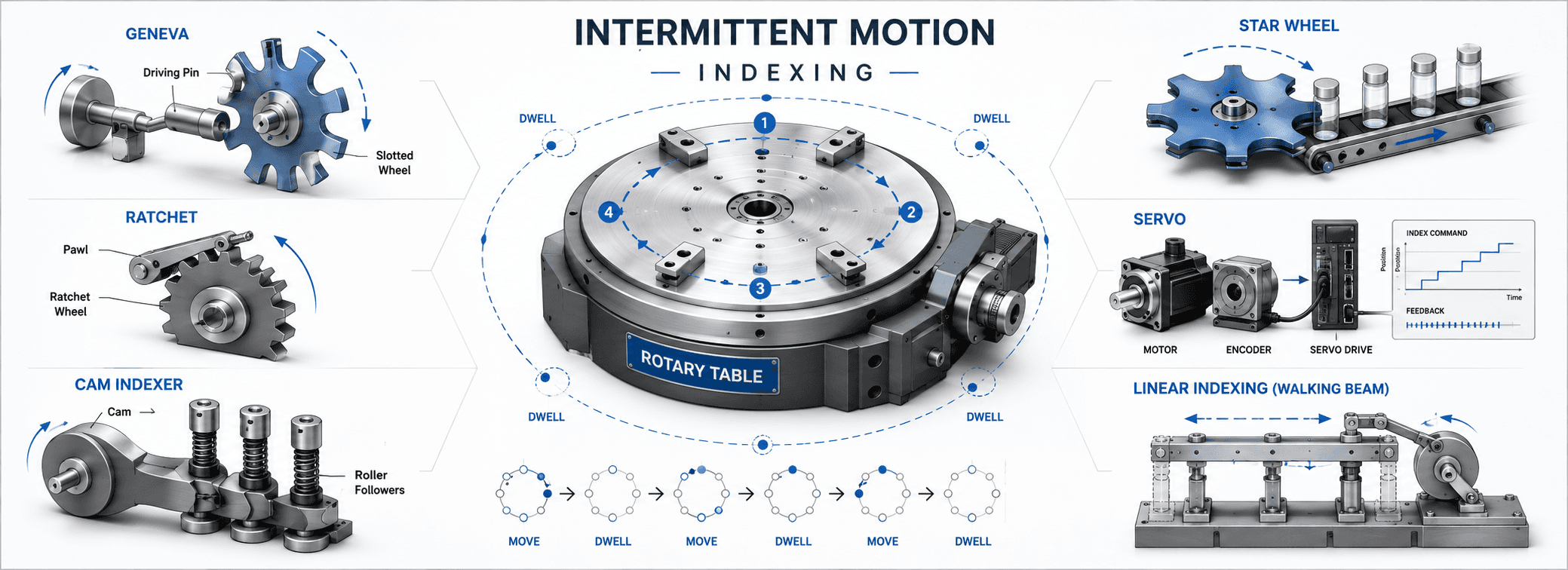
Intermittent and Indexing Mechanisms

An intermittent mechanism is a mechanical system that converts continuous rotary or reciprocating input motion into repeated movement and dwell at defined…

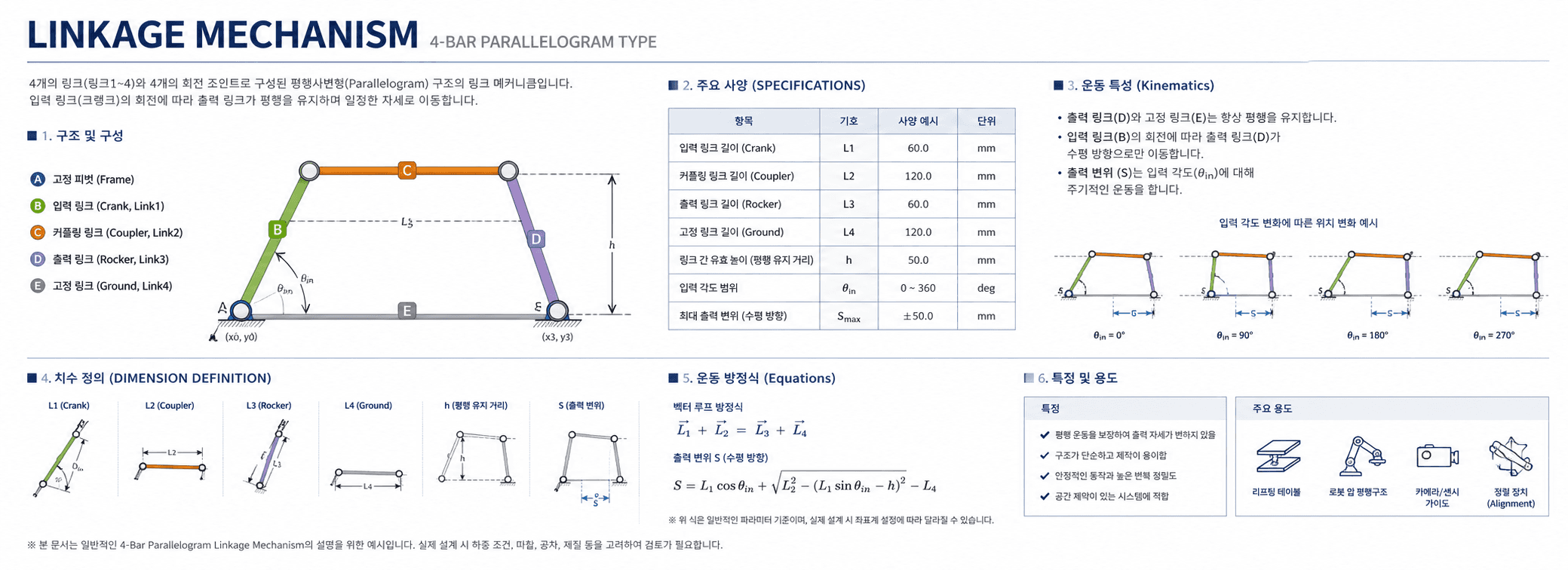
Linkage Mechanisms

A linkage mechanism is a mechanical system composed of multiple rigid links connected by revolute joints, prismatic joints, or other mechanical joints to…

Motion Conversion Mechanisms

A motion conversion mechanism is a mechanical structure that changes the motion generated at the input into a different form of motion required by the…

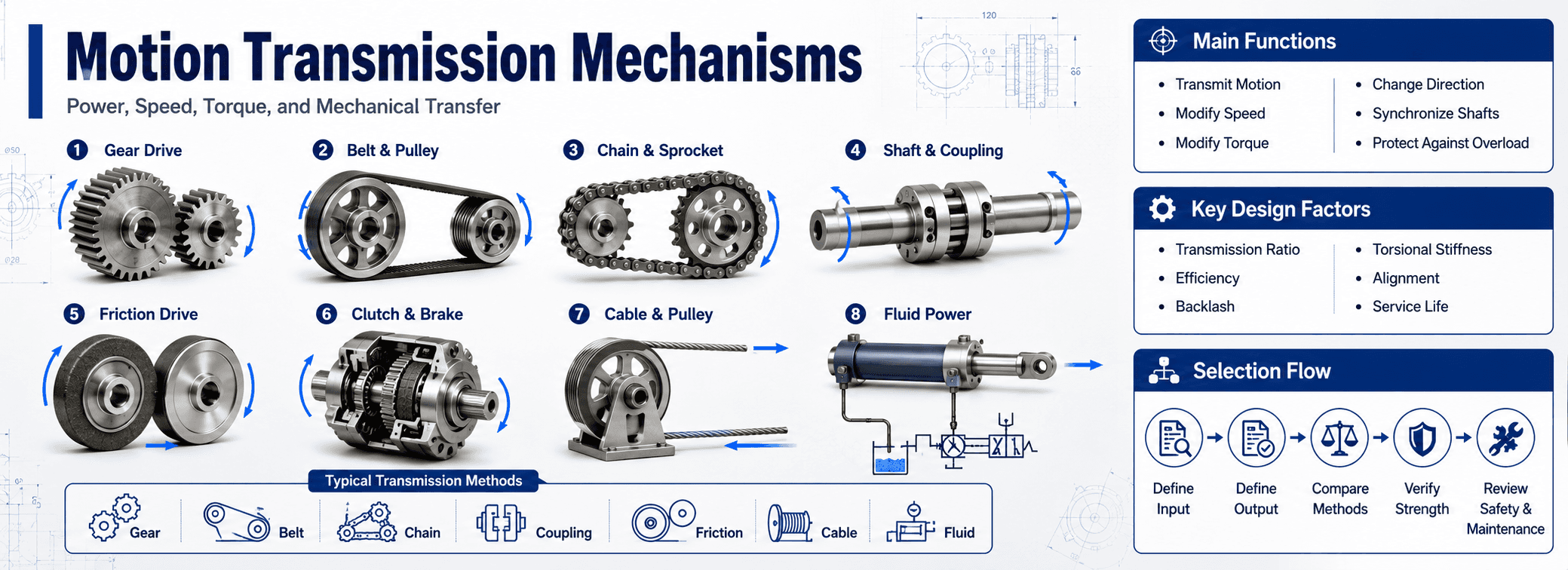
Motion Transmission Mechanisms

A motion transmission mechanism is a mechanical system that transfers motion and power generated by a power source to a working unit or another mechanical…

Relationship and Connection Structure Between Mechanism and Motion

In a mechanical system, Mechanism and Motion are not separate concepts.

Concept and Classification of Mechanism & Motion

A machine performs its intended function by transmitting the force and motion generated by a power source to the working unit and converting them into the…

Force Amplification Mechanism

A force amplification mechanism is a mechanical system that converts a relatively small input force or input torque into a larger output force or output…